

What Is a PWA? And Does Your Business Actually Need One?
Progressive Web Apps combine the accessibility of a website with many of the features of a mobile app. Here's what they are, how they work and when they make sense for your business.
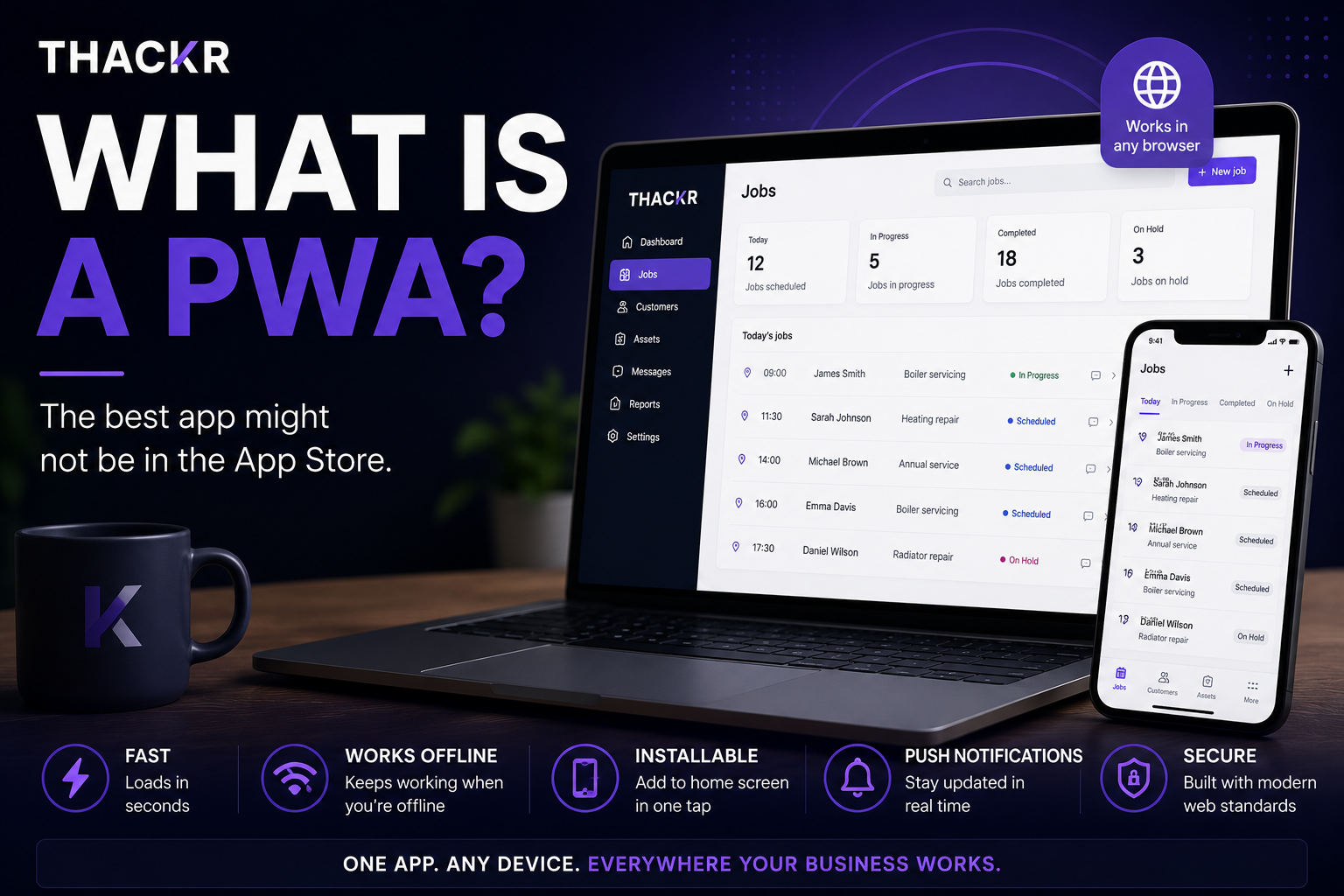
If you’ve started looking at software for your business, you’ve probably come across the term PWA, which stands for Progressive Web App.
It sounds technical, but the idea is actually quite simple.
A PWA is a website that behaves much more like an app. It can be installed on a phone or computer, load quickly, work without an internet connection in many situations and give users a much smoother experience than a traditional website.
For many businesses, it’s the best of both worlds.
What is a Progressive Web App?
When you visit a normal website, you open your browser, type in the address and use the site until you close it.
A Progressive Web App starts in exactly the same way.
The difference is that users can install it onto their device and launch it straight from their home screen, just like any other app.
Depending on how it’s built, a PWA can:
Be installed directly from a browser
Load quickly
Continue working when the internet connection is poor or unavailable
Send push notifications
Use features such as the camera or location where supported
Keep users signed in between visits
To most users, it simply feels like an app.
How is it different from a website?
Traditional websites are mainly designed to display information.
A Progressive Web App is designed to help people complete tasks.
Imagine an engineer arriving at a customer’s property.
Instead of logging into several different systems, they open one application where they can:
View today’s jobs
Read customer notes
Upload photographs
Record parts used
Capture signatures
Complete the job
Everything happens within one interface, making the experience much quicker and easier.
How is it different from a native app?
Native apps are downloaded from the Apple App Store or Google Play.
They’re built specifically for each operating system and usually have full access to the features on your device.
That sounds great, but it isn’t always necessary.
Many businesses don’t need separate iPhone and Android apps.
A Progressive Web App can often provide everything they need while costing less to build and maintain.
It also means improvements can be rolled out instantly without waiting for users to update their app.
When does a PWA make sense?
Progressive Web Apps work particularly well for businesses that need software used regularly by staff or customers.
Common examples include:
Customer portals
Booking systems
Asset management
Field service software
Internal business systems
Staff dashboards
Inventory management
Job management
Because users simply visit a web address, getting started is much easier than asking them to download an app from an app store.
A real-world example
Imagine you have engineers working across the country.
Each engineer needs access to:
Their daily schedule
Customer details
Job notes
Photos
Parts used
Customer signatures
A Progressive Web App allows them to access everything from one application on their phone, tablet or laptop.
If they lose signal while working, many features can continue working until they’re back online.
The office receives updates as soon as the engineer reconnects, helping everyone stay on the same page.
When is a native app the better option?
There are still plenty of situations where a native app is the right choice.
If your software relies heavily on Bluetooth devices, augmented reality, advanced camera features or other specialist hardware, native development may offer capabilities that a PWA can’t.
Likewise, if your business wants customers to discover the app through the App Store or Google Play, publishing a native app could be the better route.
Every project is different, so the right choice depends on what you’re trying to achieve.
So should your business build a PWA?
If you’re building:
A customer portal
An internal business system
A booking platform
Field service software
Asset management software
A staff dashboard
There’s a good chance a Progressive Web App will do everything you need.
If you’re building a consumer app with advanced hardware requirements or you want to maximise visibility through app stores, native development may be a better fit.
The important thing is choosing the technology that suits your business, rather than choosing technology because it’s popular.
Final thoughts
Many businesses start by asking,
“Should we build an app?”
A better question is,
“What problem are we trying to solve?”
Once you’ve answered that, deciding between a website, a Progressive Web App and a native app becomes much easier.
For many SMEs, a PWA offers an excellent balance between functionality, cost and long-term maintenance.
The best software isn’t the one built with the newest technology. It’s the one that solves the right problem in the simplest and most reliable way.
Looking at building a business app?
Whether you need a customer portal, an internal business system or software for your field team, the first step is understanding the problem you’re trying to solve.
At Thackr, I work with businesses to understand their processes before recommending the right solution. Sometimes that’s a Progressive Web App. Sometimes it’s a web application or a native app.
The goal is always the same. Build software that helps your business work better.
Related insights

The AI Agent That Assumes: Why Automation Needs to Ask, Not Guess
AI agents are good at filling in gaps quietly, which is exactly the problem. Here's why business automation needs to be built to ask rather than assume, with real examples.

You Inherited a System Nobody Can Explain. Now What?
When you inherit software with no documentation and no developer to ask, the temptation is to rewrite it fast. Here's a safer way to work out what it actually does first.

Your AI Coding Assistant Doesn't Remember Last Week's Decisions
AI coding agents don't carry memory of past decisions between sessions the way a human developer does. That gap shows up as inconsistency in your codebase, and it matters more than most people realise.