

When Spreadsheets Stop Scaling: Knowing When It’s Time for Bespoke Software
Spreadsheets are fantastic until your business starts to outgrow them. Here's how to recognise the signs and why purpose-built software often becomes the better long-term solution.
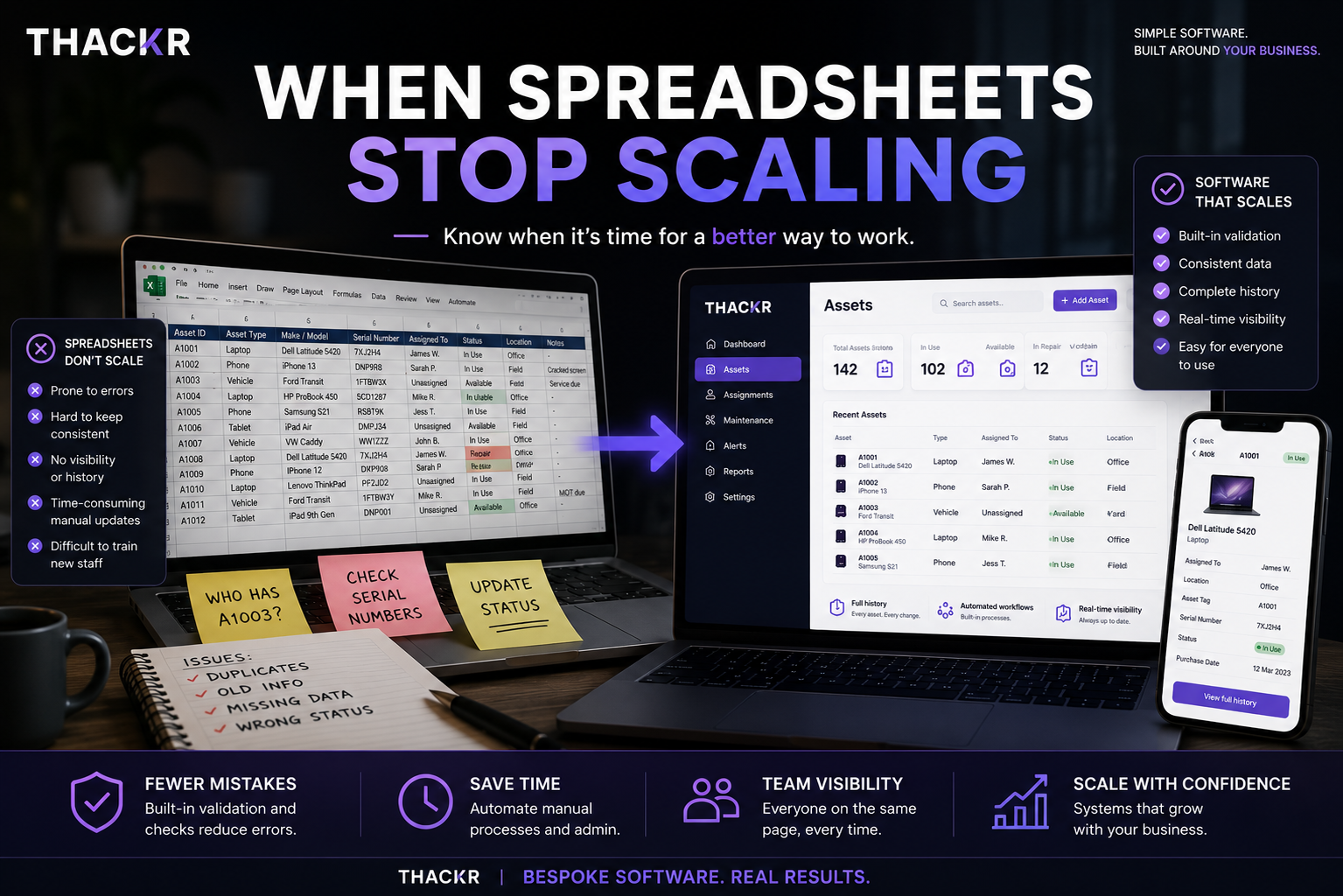
Spreadsheets are one of the most powerful tools a business can start with.
They’re quick to create, easy to update and almost everyone already knows how to use them. For many businesses, a spreadsheet is the perfect way to keep track of customers, jobs, assets or stock without investing in dedicated software.
In the early days, they solve real problems.
The challenge is that businesses don’t stay the same forever.
As your team grows, your processes become more complex and more people need access to the same information. That’s usually the point where a spreadsheet starts becoming a bottleneck rather than a solution.
Why spreadsheets work so well
There’s a reason businesses rely on spreadsheets.
They’re flexible, familiar and require very little setup. Need another column? Add one. Want a new report? Create a formula. Need to track something else? Add another sheet.
When one or two people are maintaining the data, everything feels manageable.
For many small businesses, that’s exactly the right approach.
Not every problem needs bespoke software.
The point where they begin to break down
Problems usually don’t appear overnight.
Instead, they creep in as the business grows.
Someone forgets to update a row.
A formula gets overwritten.
Two people edit the spreadsheet at the same time.
A new employee enters information differently from everyone else.
Suddenly people are asking questions like:
Which version is the latest?
Has this already been updated?
Who changed this information?
Why is this data missing?
Is this report actually accurate?
The spreadsheet hasn’t necessarily failed.
It’s simply reached the limits of what it was designed to do.
A real example: Managing company assets
Recently, I came across a business managing company assets using spreadsheets.
The spreadsheet tracked items such as:
Mobile phones
Laptops
Tablets
Vehicles
Accessories
At first, it worked perfectly.
There weren’t many assets, only a few people were updating the spreadsheet and everyone understood how it worked.
As the business grew, things became more difficult.
New employees needed training on how to update the spreadsheet correctly.
Different people recorded information in different ways.
Occasionally rows were overwritten or incomplete.
Simple mistakes started creating unnecessary work because someone always had to double-check that the information was correct.
The spreadsheet itself had become something that required managing.
The real problem isn’t the spreadsheet
This isn’t really a story about spreadsheets.
It’s a story about relying on people to remember processes.
When your business process exists only in someone’s head or in a training document, mistakes become inevitable.
Every new member of staff needs to learn the same rules.
Every experienced member of staff develops their own shortcuts.
Eventually, consistency becomes difficult to maintain.
Software doesn’t just store information
One of the biggest misconceptions about bespoke software is that it’s simply a nicer-looking spreadsheet.
It isn’t.
Well-designed software guides people through the correct process from start to finish.
Instead of expecting someone to remember what information needs recording, the system asks for it.
Instead of relying on everyone following the same process, the software enforces it.
Using the asset management example, a bespoke system could:
Require essential information before an asset can be assigned.
Prevent duplicate asset numbers or serial numbers.
Record who currently has each asset.
Keep a complete history of assignments and returns.
Track warranty information.
Record maintenance and repairs.
Notify managers when important information is missing.
Control who can edit different types of data.
Rather than relying on training alone, the process becomes part of the software itself.
That dramatically reduces the opportunity for human error.
Consistency beats complexity
Many businesses assume bespoke software is about adding features.
In reality, it’s often about removing uncertainty.
Good software makes the right way of doing something the easiest way.
It helps every employee follow the same process, whether they’ve worked there for ten years or ten days.
That consistency becomes increasingly valuable as a business grows.
When is it time to move beyond spreadsheets?
There’s no magic number.
Some businesses successfully use spreadsheets for years.
Others outgrow them surprisingly quickly.
Some common signs include:
Multiple people updating the same spreadsheet every day.
Staff regularly asking how information should be entered.
Time spent checking data instead of using it.
Different versions of the same spreadsheet appearing.
Important business processes depending on manual updates.
Growing concerns about mistakes or missing information.
If any of these sound familiar, it may be worth stepping back and asking whether the process itself has outgrown the tool.
Final thoughts
Spreadsheets aren’t the enemy.
They’re one of the best tools available for getting a business started and solving problems quickly.
But every tool has its limits.
As your business grows, the goal shouldn’t be to build a bigger spreadsheet. It should be to build better processes.
Purpose-built software doesn’t just organise your data—it helps your team work consistently, reduces avoidable mistakes and creates a foundation that can grow alongside your business.
If you’re spending more time managing spreadsheets than the work they’re supposed to support, it might be time to consider a different approach.
Need a system that fits your business?
At Thackr, I build bespoke software around the way your business already works—not the other way around.
Whether you’re managing assets, streamlining internal processes or replacing spreadsheets that have become difficult to maintain, the goal is always the same: simpler workflows, fewer mistakes and software that grows with your business.
Let’s build something that works for the long term.
Related insights
The AI Agent That Assumes: Why Automation Needs to Ask, Not Guess
AI agents are good at filling in gaps quietly, which is exactly the problem. Here's why business automation needs to be built to ask rather than assume, with real examples.

You Inherited a System Nobody Can Explain. Now What?
When you inherit software with no documentation and no developer to ask, the temptation is to rewrite it fast. Here's a safer way to work out what it actually does first.
Your AI Coding Assistant Doesn't Remember Last Week's Decisions
AI coding agents don't carry memory of past decisions between sessions the way a human developer does. That gap shows up as inconsistency in your codebase, and it matters more than most people realise.